

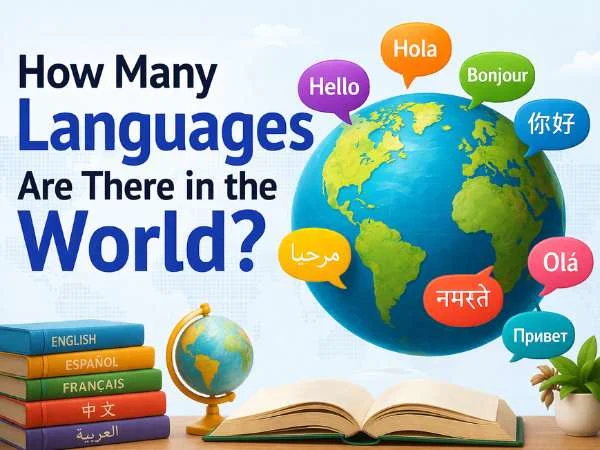
Have you ever traveled somewhere and realized you couldn’t read a single sign or order a cup of coffee? Our world is incredibly diverse, but it’s easy to forget that when we live in our own little linguistic bubbles!
But all it takes is a trip to a place where you don’t speak the local tongue to realize just how huge the world is. That feeling of not being able to communicate really shines a light on the amazing variety of ways humans have figured out how to talk to each other!
The Big Number: Prepare to Be Shocked!
So, how many languages are there? The number will probably blow your mind. According to language experts, there are currently 7,168 living languages spoken around the world today!
That’s right—over seven thousand! However, things are a bit lopsided. While we have thousands of unique languages, the vast majority of the world’s population only speaks a tiny handful of them. This leaves thousands of other languages with just a small group of speakers.
The Heavy Hitters of the Globe
We all know the big ones: Mandarin Chinese, English, Hindi, and Spanish. These languages basically rule the world! Billions of people use them every single day for business, school, and chatting online.
Because these languages are so useful for getting a job or traveling, they spread like wildfire. But sadly, as everyone rushes to learn the big languages, many smaller, local languages get pushed out of the way.
The True Language Champions

So, where are all these thousands of languages hiding? You might guess big countries have the most, but the real hotspots are often isolated places.
The undisputed champion of language diversity is Papua New Guinea! Even though it’s a relatively small island nation, people there speak over 840 different languages. How is that even possible? Well, the country is full of dense jungles and massive mountains. For thousands of years, tribes lived totally cut off from each other, allowing them to create their own completely unique ways of speaking!
Asia and Africa Take the Lead
When we look at the big picture, Asia and Africa are the real kings of language. Together, they hold about 60 percent of all the languages on Earth!
Asia boasts over 2,300 languages, while Africa has more than 2,100. This massive variety comes from deep history, diverse cultures, and different landscapes. Meanwhile, Europe is actually pretty quiet on the language front, with only about 290 native languages.
The Sad Truth: Dying Voices
Despite having over seven thousand languages today, we are losing them at a scary pace. Experts believe that about 40 percent of all languages are currently in danger of dying out entirely. In fact, we lose an average of one unique language every two weeks! Once the last fluent speaker passes away, that language—along with its unique jokes, ancient stories, and local wisdom—is gone forever.
Why Are We Losing Them?
It usually comes down to money and opportunity. In our modern world, getting a good job or going to a big university usually requires knowing a dominant language like English or Mandarin.
Because of this, younger generations often stop learning the language their grandparents spoke. They move to big cities, speak the dominant language to fit in, and the old words just slowly fade away over time.
The Loneliest Speakers
The saddest part of this trend is the existence of “moribund” languages—languages that kids just aren’t learning anymore. In some extreme cases, there might be only one single person left on Earth who speaks a specific language! When that person passes away, their unique words, jokes, and stories vanish with them.
Can We Save Them?
Linguists and researchers are racing against the clock to record these dying languages before it’s too late. They use digital recordings and build dictionaries to capture the words.
But while recording a language is great for the history books, it doesn’t keep the language alive. For a language to truly survive, people actually need a reason to speak it every day!
also read : – Why Modular Classrooms Are the Smart Choice for UK Schools
Why Should We Even Care?
You might be wondering, why does it matter if everyone just speaks English? Well, language isn’t just a tool to order a coffee; it literally shapes how we see the world!
For example, instead of saying ‘there is a bug on your left leg,’ some Indigenous tribes in Australia would say ‘there is a bug on your southwest leg.’ They only use compass directions like north, south, east, and west. Because of this, their brains are hardwired to always know exactly which way they are facing! When a language dies, we lose incredible, unique ways of thinking just like that.
Language is Always Changing

While it’s sad to lose old languages, human communication is always growing and changing. Teenagers invent new slang every day, and the internet creates entirely new ways for us to chat! Language is a living thing that constantly adapts to fit what we need.
The Perks of Learning a New Language
If you ever get the chance, try learning a new language! It’s fantastic for your brain, improves your memory, and helps you connect with completely different cultures. It truly opens up the world in a way nothing else can!
Frequently Asked Questions (FAQ)
What is the most spoken language?
If you only count native speakers, Mandarin Chinese takes the gold medal! But if you include people who learned it as a second language, English is the most widely spoken language on the planet.
What is the hardest language to learn?
It totally depends on what language you already speak! For an English speaker, languages with entirely different alphabets (like Arabic) or tonal systems where the pitch changes the word’s meaning (like Mandarin) are usually the toughest.
How many languages are in Europe?
Only about 290! Compared to the rest of the world, Europe actually has very little language diversity.
Which language has the most words?
This is a tough one to measure! English has a massive dictionary because it borrows words from everyone else. But languages like Korean or Turkish can basically build an endless amount of words by stacking small sounds together!
Can you learn a language while sleeping?
Nope, that’s just a fun myth! Listening to audio while you sleep won’t magically make you fluent. You have to do the hard work while you’re awake!
What is a “dead” language?
A dead language is one that no longer has any native speakers who use it in their everyday lives. Latin is the most famous example—people still study it, but nobody uses it to order a pizza!
Final Thoughts
The fact that humans have created 7,168 different ways to talk is just amazing! It shows how creative we really are. But as the world gets smaller and more connected, we need to remember how valuable these unique voices are. Every language holds a special piece of human history, and we should do our best to celebrate and protect that diversity!