

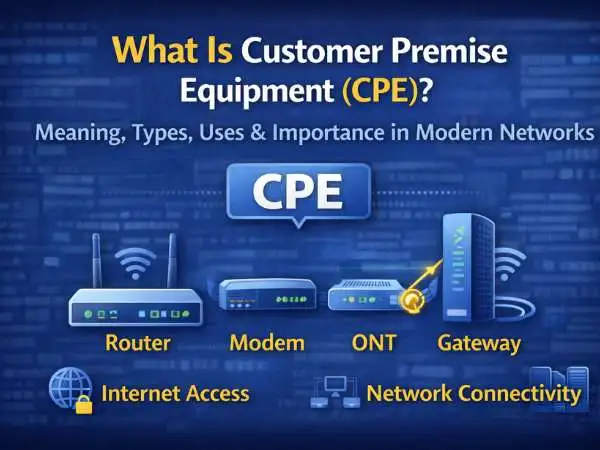
If you’ve ever installed a router at home, used a modem from your internet provider, or managed network hardware in an office, you’ve already interacted with customer premise equipment, even if you didn’t know the term. In networking, telecom, Wi-Fi, and even e-commerce discussions, CPE appears constantly. Still, many people pause and ask: customer premise equipment meaning, what is CPE used for, what types of CPE exist, or what is CPE in networking and Wi-Fi.
CPE is not a single device. It is a category. It includes all the equipment placed at a customer’s location to enable communication services. Understanding CPE helps you understand how internet, voice, video, and digital services actually reach end users.
This blog explains CPE in full depth. You’ll learn what customer premise equipment means, real examples, how CPE works, where it’s used, the benefits of using CPE, types of CPE including black, white, and gray box models, how CPE works in Wi-Fi and networking, how it appears in e-commerce, and how traditional CPE compares with vCPE.
Customer Premise Equipment Meaning
Customer premise equipment, often shortened to CPE, refers to any physical device located at the customer’s site that connects them to a service provider’s network.
The “customer premises” can be:
- a home
- an office
- a store
- a factory
- a campus
The “equipment” includes hardware that enables communication services like internet access, voice calls, video streaming, or data transfer.
In short, CPE sits at the edge of the provider’s network and the beginning of the customer’s network.
also read : – Temperature Apps For IPhone: Monitor Temperature On Your IPhone
What Is Customer Premise Equipment in Simple Terms
In simple terms, CPE is the equipment you see and touch.
If a service provider delivers a connection, the CPE is the device that:
- receives that connection
- converts it into usable service
- distributes it within the premises
Without CPE, the service would stop at the provider’s cable or fiber line.
Customer Premise Equipment Examples
To understand CPE clearly, examples help more than definitions.
Common customer premise equipment examples include:
- modems
- routers
- Wi-Fi access points
- set-top boxes
- VoIP phones
- network switches
- firewalls
Each of these devices plays a specific role, but all qualify as CPE because they operate on the customer’s side.
Everyday CPE You Probably Use
Most homes already use multiple CPE devices.
For example:
- a modem connects your home to the ISP
- a router manages traffic and security
- a Wi-Fi access point spreads the signal
Together, they form your local network.
What Is CPE Used For
People often ask, what is CPE used for in real-world scenarios.
CPE is used to:
- connect customers to service providers
- manage local network traffic
- provide Wi-Fi connectivity
- secure data transmission
- support voice and video services
CPE acts as the translator between external networks and internal devices.
CPE as the Network Edge
In networking terms, CPE sits at the network edge.
This means:
- it receives traffic from outside
- it processes and filters that traffic
- it delivers it to internal devices
Edge placement makes CPE critical for performance and security.
also read : – How to Use Promo Codes to Get the Perfect Bed for Your Cat and Dog
What Is CPE in Networking
When people ask what is CPE in networking, they are referring to how CPE fits into network architecture.
In networking, CPE:
- terminates provider connections
- manages IP addressing
- applies routing rules
- enforces security policies
It is the first networking intelligence inside the customer environment.
Role of CPE in Network Architecture
In a typical setup:
- the service provider controls the core network
- the customer controls the internal network
- CPE sits between them
This division allows clear responsibility boundaries.
What Is CPE in WiFi
What is CPE in WiFi usually refers to devices that provide wireless access at the customer site.
Wi-Fi CPE includes:
- wireless routers
- dedicated access points
- outdoor wireless CPE units
These devices convert wired internet signals into wireless coverage.
WiFi CPE in Homes and Offices
In homes, Wi-Fi CPE focuses on convenience and coverage.
In offices, Wi-Fi CPE focuses on:
- capacity
- security
- user segmentation
The same concept applies, but scale and configuration differ.
also read : – Best Software for Data Wiping that is DoD Compliant?
What Types of CPE Exist
Understanding what types of CPE exist helps clarify how broad the category really is.
CPE can be grouped by function, ownership, or design.
Modem-Based CPE
Modems convert signals from:
- cable
- fiber
- DSL
They are often the first CPE device connected to the provider line.
Routing CPE
Routers manage:
- traffic direction
- IP addressing
- firewall rules
Most modern routers combine multiple functions into one device.
Wireless CPE
Wireless CPE includes:
- indoor Wi-Fi access points
- outdoor point-to-point units
- fixed wireless receivers
These are common where wired connections are limited.
Voice and Video CPE
Voice and video CPE supports:
- VoIP phones
- set-top boxes
- conferencing equipment
These devices handle specialized data streams.
also read : – Unblocked Games World: Get the List of Games popular Unblocked Games here!
Black, White, and Gray Box CPE
One of the most discussed classifications is black, white, and gray box CPE.
Black Box CPE
Black box CPE is:
- fully controlled by the provider
- locked down
- not customizable by the customer
Customers use it, but do not manage it.
White Box CPE
White box CPE is:
- hardware with open software
- highly customizable
- often used by advanced users or enterprises
It offers flexibility but requires expertise.
Gray Box CPE
Gray box CPE sits in between.
It allows:
- limited customization
- provider oversight
- shared responsibility
This model balances control and flexibility.
Benefits of Using a CPE
The benefits of using a CPE go far beyond basic connectivity.
Improved Connectivity
CPE ensures:
- stable access
- consistent performance
- reliable signal distribution
It adapts provider services to local conditions.
Better Network Control
CPE gives customers control over:
- device access
- bandwidth usage
- security rules
This control improves efficiency and safety.
Enhanced Security
Modern CPE includes:
- firewalls
- encryption support
- intrusion protection
Security at the edge reduces risk.
Scalability and Flexibility
CPE allows networks to:
- grow gradually
- add new devices
- upgrade services
This makes expansion manageable.
also read : – Synergy EGUSD Login- All Details Regarding Synergy EIK Grove Official Portal
Customer Premises Equipment in E Commerce
Customer premises equipment in e commerce plays a behind-the-scenes role.
E-commerce operations rely on:
- stable connectivity
- secure transactions
- reliable internal networks
CPE ensures online stores remain accessible and protected.
CPE in Warehouses and Retail Stores
Retail environments use CPE to:
- connect point-of-sale systems
- manage inventory networks
- support Wi-Fi for customers
Downtime here directly affects revenue.
CPE vs vCPE
A modern comparison often asked is CPE vs. vCPE.
Traditional CPE
Traditional CPE:
- relies on physical hardware
- runs fixed software
- requires on-site upgrades
It is reliable but less flexible.
What Is vCPE
vCPE stands for virtual customer premise equipment.
In vCPE:
- functions move to software
- processing shifts to the cloud
- hardware becomes simpler
This changes how services are delivered.
Advantages of vCPE
vCPE offers:
- faster updates
- lower hardware costs
- centralized management
Service providers gain agility.
Challenges of vCPE
vCPE also introduces:
- dependency on cloud connectivity
- performance considerations
- new security models
It is not a universal replacement yet.
also read : – What Is Fire Alarm Used For?
CPE Management and Maintenance
Managing CPE involves:
- firmware updates
- configuration backups
- monitoring performance
Poor management leads to outages.
Who Owns the CPE
Ownership varies.
- ISPs often own rented CPE
- customers may own purchased devices
- enterprises mix both models
Ownership affects control and responsibility.
CPE and Service Level Agreements
CPE performance often impacts SLAs.
Providers define:
- uptime expectations
- support boundaries
- replacement terms
Clear agreements prevent disputes.
Security Risks Related to CPE
Unsecured CPE can become:
- entry points for attackers
- sources of data leaks
- botnet targets
Regular updates and strong passwords reduce risk.
Future of Customer Premise Equipment
CPE continues to evolve with:
- cloud integration
- software-defined networking
- automation
The boundary between hardware and software keeps shifting.
Why Understanding CPE Matters
Understanding CPE helps:
- network professionals design better systems
- businesses avoid downtime
- users troubleshoot issues
CPE may sit quietly, but it carries heavy responsibility.
also read : – How To Learn Photography On Your Own
Final Thoughts on Customer Premise Equipment
Customer premise equipment is the foundation of modern connectivity. From home Wi-Fi routers to enterprise firewalls, CPE connects customers to the digital world. It shapes performance, security, and reliability across industries.
As networks evolve, CPE evolves with them—becoming smarter, more flexible, and more software-driven.
FAQs: Customer Premise Equipment
What is customer premise equipment
Devices located at the customer site that connect to service provider networks.
What is CPE used for
To enable internet, voice, video, and data services.
What is CPE in networking
The edge device that manages traffic between provider and customer networks.
What is CPE in WiFi
Devices that provide wireless connectivity at customer locations.
What is the difference between CPE and vCPE